

A garment that looks perfect on the sewing line can still fail at the final check — a loose thread, an uneven seam, a fabric flaw that only shows up under the right light. Garment checking tables exist specifically to catch these issues before a product moves any further down the line, which is why the right table, in the right configuration, matters more than it might seem.
Anand Furnishers manufactures garment checking tables in a range of configurations for different stages of production. This blog walks through the main types available, what each one is built for, and what to check before choosing one for your unit.
Multiple Types of Garment Checking and Finishing Tables
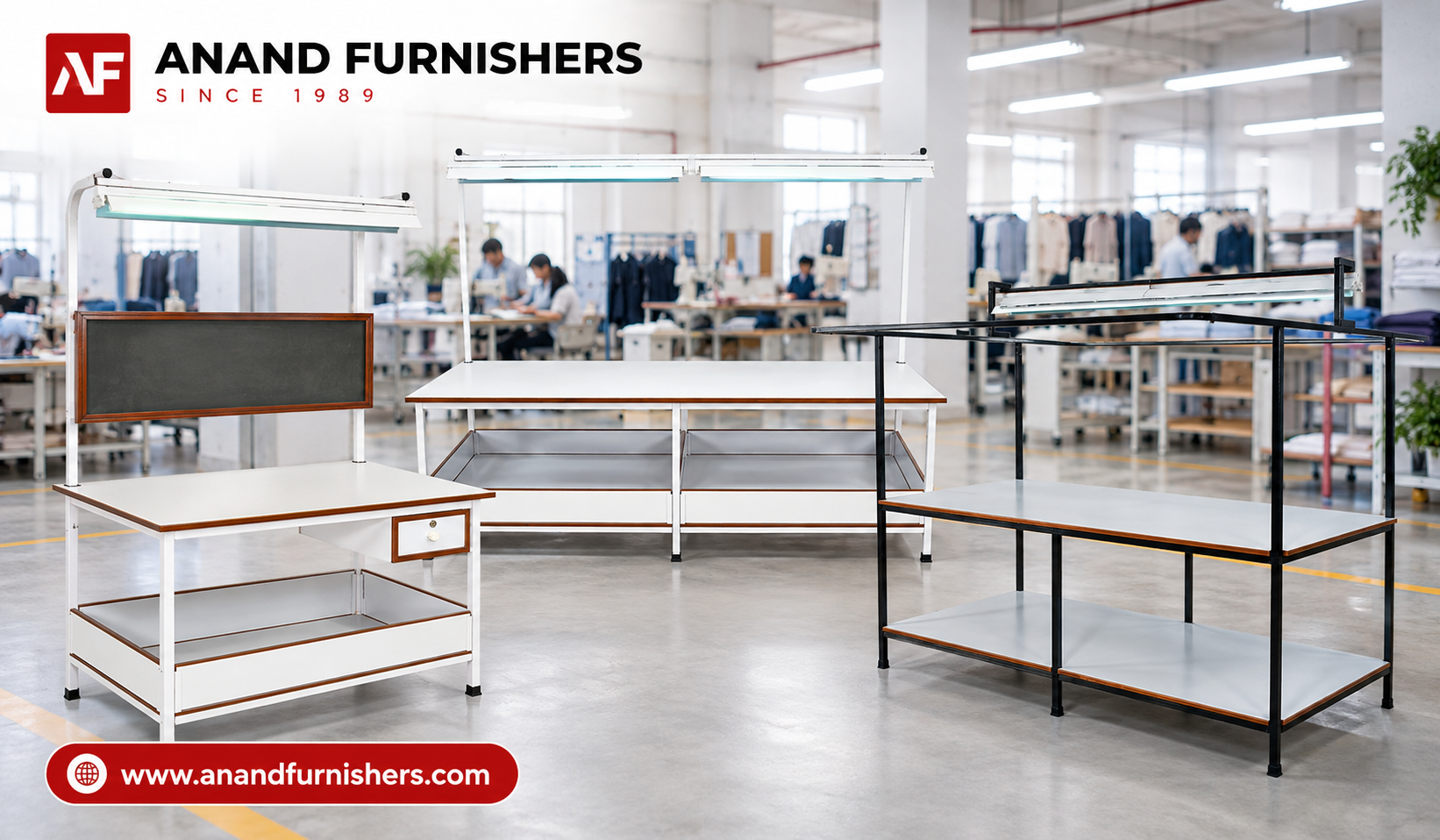
Not every checking table does the same job. Depending on where it sits in the production process, you’ll typically find:
- Standard Checking Table — fitted with top, bottom, and task lighting, available in sizes like 2400x1200mm, 1800x1200mm, or 1500x900mm, used for general garment inspection
- Checking Table with Light and Fan Arrangement — adds a fan alongside the lighting, useful for operators doing extended inspection work at one station
- Checking Table with Side Hanger Arrangement — includes a hanger rail so garments can be inspected while hanging rather than laid flat, keeping the surface clear
- Checking Table with Bottom Box — a welded mesh box built into the base, useful for holding checked pieces without needing separate storage nearby
- Checking Table with Box — fitted with two bins at the bottom specifically for segregating approved and rejected pieces on the spot
- In-Line Checking Table — positioned directly within the assembly line, so garments are checked as part of the production flow rather than at a separate station
- Fabric Checking Table / QC Table — built with a frosted glass top and lighting both above and below, designed to catch fabric defects before the material even reaches cutting
- Finishing Table with Task Light Arrangement — combines task lighting with a bottom board and side hangers, suited to the finishing stage rather than early-line checking
Most garment units end up using more than one of these, matched to the specific stage — fabric inspection, in-line checking, and final finishing all tend to call for slightly different setups.
Key Features to Look for in a Garment Checking Table
Beyond picking the right type, a few construction details affect how well a table performs day to day:
- PLB (pre-laminated board) top and bottom, for a durable surface that holds up under daily handling
- Reliable task lighting, positioned to make small defects easy to spot without eye strain
- Custom sizing options, since a table built for a small QC station won’t suit a full in-line setup, and vice versa
- Sturdy MS frame construction, to keep the table stable during repeated daily use
Where Garment Checking Tables Are Used
These tables show up at more than one point in a garment unit’s workflow:
- Fabric inspection, before cutting begins, to catch defects in the raw material itself
- In-line quality checks, during the sewing and assembly stages, to catch issues early
- Final inspection before packing, to confirm the finished garment meets quality standards before it’s dispatched
Catching a defect earlier in this sequence is almost always cheaper and easier to fix than catching it at the very end.
Why a Dedicated Checking Table Makes a Difference
It’s tempting for smaller units to improvise with a regular worktable instead of a purpose-built checking table, but a few things get lost in that shortcut:
- Consistent lighting is hard to replicate without a table built specifically to position it correctly over the inspection surface
- Defect detection accuracy drops under uneven or dim lighting, especially for fine issues like loose threads or subtle fabric flaws
- Segregation slows down without built-in bins or boxes, since checked pieces need somewhere defined to go immediately
- Operator fatigue increases over a full shift without proper lighting and a stable, correctly sized surface to work at
A dedicated table isn’t just a nicer version of a regular table — it’s built around the specific job of finding defects quickly and accurately.
FAQs About Garment Checking Tables
- What’s the difference between a checking table and a fabric checking table?
A standard checking table is used to inspect garments at various production stages, while a fabric checking table is specifically built with under-and-over lighting to detect defects in raw fabric before cutting. - Can checking tables be customized in size for my factory floor?
Yes, most checking and finishing tables are available in standard sizes but can typically be customized to fit your available space and workflow. - Why do some checking tables have a fan attached?
A fan is added for operator comfort during extended inspection work, since checking stations often require staff to stay at one table for long stretches. - What is a QC table used for specifically?
A QC table, similar to a fabric checking table, uses a frosted glass top with lighting to help operators spot fabric defects clearly before further processing. - Do checking tables need electrical wiring for the lighting?
Yes, tables with light or fan arrangements require electrical connections, and this work is typically priced separately from the table itself. - Can the same table be used for both checking and finishing?
Some configurations, like tables with task lighting and side hangers, are suited to both checking and finishing tasks, though dedicated setups often work better for high-volume lines. - What size checking table is best for a small garment unit?
Smaller units often do well with compact sizes like 1500x900mm or 1200x900mm, while larger production lines typically need bigger tables like 2400x1200mm.
Conclusion
Quality control in garment manufacturing depends on having the right table for the right stage, not just any flat surface with good lighting. Garment checking tables from Anand Furnishers cover everything from fabric inspection to final finishing, with sizing and configuration built around how your production line actually works. Get in touch to discuss the right setup for your unit.